Great meals often get decided before you turn on a burner. According to Fox News, Los Angeles-based cookbook author Carmen Perr, who wrote "Cook What Grows," argues that better home cooking starts at the market, with smarter choices about which fruits, vegetables and herbs go in your basket. Her core advice: pay attention to texture, color and aroma.
This guide turns that idea into a simple habit you can use at a farmers market, a corner stand or a supermarket aisle. You won't need a recipe in hand, and you won't need to rely only on labels.
Why the market matters more than the recipe
A recipe can only do so much with tired ingredients. Perr's point, as reported by Fox News, is that quality is set at the moment of selection. If you pick well, a simple preparation can taste good because the ingredient is doing the work.
There's a practical upside too. Cooking affordably and seasonally at home is on a lot of people's minds, and choosing well means you waste less of what you pay for. It also makes farmers markets less intimidating: you don't need to know every variety, just how to read what's in front of you.
The three-sense check
Perr's approach, per Fox News, centers on three cues. Treat them as a quick routine you run on anything you're about to buy.
1. Texture: use your hands
Texture tells you a lot about freshness and ripeness. Pick the item up and handle it gently. Ask yourself a few questions:
- Does it feel heavy and firm, or limp and soft where it shouldn't be?
- Do leafy greens and herbs look and feel crisp rather than wilted?
- Does the skin feel intact, or is it bruised or mushy?
Gentle is the key word. Pressing hard leaves damage for the next shopper and for you.
2. Color: look for life
Color is the fastest check, because you can do it from a few feet away. Look for vivid, even color that suits the item. Dull, faded or patchy tones can hint that something has been sitting around or isn't at its best. Compare a few of the same item side by side, since the best one usually stands out once you've got a comparison.
3. Aroma: lean in
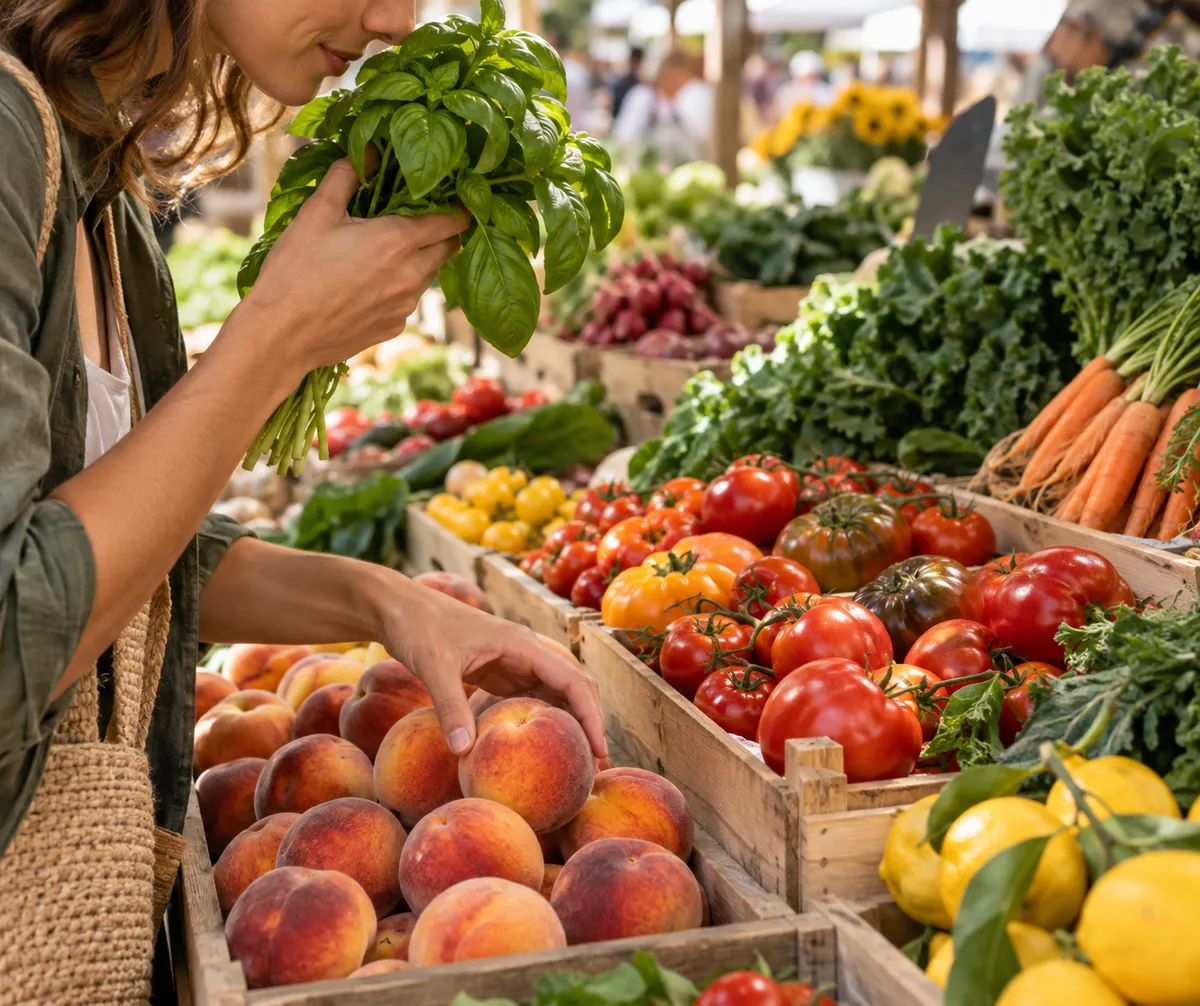
Smell is the cue many shoppers skip, and it may be the most useful for herbs and fruit. Fresh produce tends to smell like itself: bright, green and herbal for basil or mint, sweet and fragrant for ripe fruit. If there's little scent, the flavor may be muted too. A sour or off smell is your cue to put it back.
Herbs deserve the same attention
Herbs are easy to treat as an afterthought, but Perr's advice includes them alongside fruits and vegetables. They're also where aroma matters most. Rub a leaf lightly if the seller allows it, or simply lean in. Check that the leaves look perky and green and that the stems aren't slimy or dried out. A fragrant bunch can lift a plain bowl of grains, eggs or roasted vegetables with almost no extra effort.
Make it work at a farmers market
Markets are a good place to practice because the produce is out in the open and you can usually talk to the person who grew or sold it. A few habits help beginners:
- Walk the whole market first. Compare color and freshness across stalls before you buy.
- Shop what looks best, not what's on your list. Let the produce lead, then plan the meal around it.
- Ask what's good this week. Sellers often know what's at its peak.
- Buy modest amounts. Fresh produce is best used soon, and buying less helps cut waste.
That last point connects to the low-waste cooking trend that the cook-what-grows idea fits into: buy what looks and smells great, then actually use it.
Grocery store mistakes to avoid
You can apply the same senses at a supermarket, where packaging can get in the way. Common slip-ups include:
- Grabbing the first item on the pile without comparing it to others.
- Trusting the label alone. A label doesn't tell you whether the specific tomato in front of you is ripe.
- Skipping the sniff test on herbs and fruit.
- Buying by plan only. If the zucchini looks sad, swap it for something that looks better.
A simple way to turn market finds into dinner
This isn't a formal recipe, just a loose method that suits ingredients picked at their best. Choose one vegetable, one herb and one pantry staple such as pasta, rice or beans. Cook the vegetable simply, by roasting, sautéing or eating it raw if it suits. Finish with chopped fresh herbs at the end so their aroma stays bright. Taste, then add salt, acid or oil as needed. When the produce is good, you'll need fewer extras.
Your next shopping trip
Before you put anything in your basket, touch it, look at it and smell it. Do that for three items on your next trip, and let what you find shape what you cook that night.